
Humidity testing for rigid jewelry boxes is a controlled sample-approval exercise: expose representative assembled packs to an agreed atmosphere, then inspect the structural details that determine presentation and use. Buyers should document the starting condition, assess promptly in the defined environment, and decide in advance how lid fit, flatness, wrap adhesion, joints, and insert clearance will be judged.
What humidity testing means for a rigid jewelry box
A rigid jewelry box is an assembled presentation pack, not simply a sheet of paperboard. Its behavior depends on the board structure, wrapped covering, adhesive joints, lid-and-base geometry, insert, and the jewelry or substitute item placed inside. A sample can look excellent at first inspection yet reveal a practical problem after its materials have adjusted to a different humidity environment.
Relative humidity (RH) compares the actual water-vapor pressure with saturation vapor pressure at the same temperature, expressed as a percentage. It describes the atmosphere, not liquid water on the box. Buyers should ask whether the specified construction maintains acceptable presentation and function under the agreed conditioning plan.
Conditioning is holding a sample in a specified atmosphere so that later observations are meaningful and repeatable. ASTM D4332 explains that packaging materials, particularly cellulosic materials, can change physical properties as temperature and RH vary, and it provides standard and special conditioning atmospheres for packaging tests. It is a conditioning practice, not a pass/fail specification for jewelry boxes. ASTM D4332
Preconditioning is the controlled history before formal conditioning. It matters because paper and board do not necessarily arrive at the same condition simply because they later occupy the same room. ASTM D685 notes that a paper sample’s physical properties at a given RH can depend on whether it arrived from higher or lower humidity. ASTM D685
This distinction prevents a common approval error: treating an attractive, unrecorded sample as proof of repeatable performance. The approval record should state what sample was examined, its starting state, the selected method, the conditioning exposure, the assessment timing, and the acceptance criteria.
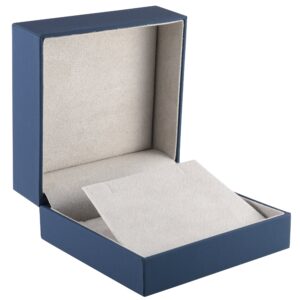
Why assembled boxes deserve a separate humidity review
Rigid jewelry packaging can reveal moisture-related movement as a visual, functional, or fit issue. The buyer’s goal is to identify which observation would make the package unsuitable for its intended presentation, rather than to create an abstract durability score.
Start with flatness and rocking. Place the assembled base and lid on a known flat reference surface. A box that rocks may feel unstable on a retail counter or in a customer’s hand. Record which component rocks, whether the movement appears at one corner or along an edge, and whether the condition changes after exposure.
Then inspect curl and bow. Curl is local turning at an edge, flap, or wrap boundary. Bow is broader curvature across a panel or wall. Either can alter the perceived squareness of a rigid box. Photograph the same viewpoints before and after conditioning; otherwise, lighting and camera angle can turn a subjective impression into an apparent defect.
Lid fit should be assessed as a system. A lift-off lid may become overly tight, loose, skewed, or uneven at the reveal. A hinged or magnetic style should be checked for alignment, closing position, and whether the lid catches or resists normal use. Do not reduce this to a single “opens” observation. Review removal, replacement, edge alignment, and the visual relationship between lid and base.
Look closely at wrap lifting and adhesive joints. Corners, wrapped edges, seams, and areas near board transitions deserve focused inspection. Record any lifting, bubbling, separation, exposed board edge, adhesive smear, or new visual telegraphing through the wrap. The question is whether the construction remains presentable under the agreed test condition, not whether a small irregularity can be explained away.
Finally, inspect insert clearance with the intended jewelry or a documented representative substitute. Humidity-related movement can alter the usable space around an insert, change how a tray sits, or make a ring slot, necklace recess, or removable cushion appear poorly fitted. Check that the item can be placed and removed as intended without forcing the box, shifting the insert, or compromising the presentation.
Separate structural humidity behavior from other moisture risks
A humidity-conditioning review is not a liquid-water test. Rain exposure, immersion, spills, condensation, and a wet shipping carton introduce liquid water and may call for a different method and separate criteria. Labeling both activities “moisture testing” creates ambiguous approvals.
It is also not a jewelry-tarnish study. Metals, plating, stones, textiles, and other jewelry materials may have their own storage and care considerations. A rigid-box approval can verify how the packaging structure behaves while holding a representative item, but it should not imply that the packaging prevents tarnish unless that claim is separately defined and evidenced.
Nor does one controlled atmosphere reproduce every warehouse, retail display, vehicle, or consumer home. ASTM D4332 permits special laboratory conditions selected to represent parts of a distribution environment, while noting that such conditions need not duplicate field conditions. ASTM D4332 Treat the chosen exposure as a decision-specific screen, and pair it with separate packed-system transit testing when distribution hazards are also in scope.
Choose the test scope before you ask for samples
The strongest buyer briefs answer three questions: what decision is being made, what construction is being approved, and what exposure is relevant to that decision.
For a material-screening scope, compare board, wrap, and adhesive options before locking the final box design. This is useful when the buyer is narrowing material routes, but it cannot by itself establish final lid fit because the complete assembly is absent.
For an assembled-box approval scope, test finished samples with their intended lid, base, wrap, closure features, and insert. This is usually the most relevant scope for a jewelry presentation box because it directly reveals interactions among components.
For a packed-configuration scope, evaluate the assembled retail box within the inner pack, shipper arrangement, protective materials, and orientation expected for the route. It does not replace a distribution test, but it can expose whether a packaging configuration changes the sample’s response or creates pressure that masks a fit issue.
Use sample groups, not one hero unit. Keep a retained reference group in the agreed baseline condition and expose one or more comparison groups under the selected plan. Include enough units to see whether an observation repeats across the sample set, while documenting any differences in construction, color, finish, insert, or packing configuration. The lab or responsible technical team should select the current applicable method and conditioning durations; do not assume a generic internet recipe applies to a specific box.
A practical decision framework for acceptance
Before samples enter conditioning, classify each checkpoint by its effect on the buyer’s decision.
Critical functional observations are conditions that prevent ordinary intended use: a lid cannot be removed or replaced normally, the closure cannot align, an insert no longer seats, or the jewelry cannot be presented or removed as intended. These call for a clearly stated disposition rule before testing.
Presentation observations affect the premium appearance but may not stop use: visible bow, rocking, uneven lid reveal, wrap lift, corner opening, or a crease that becomes noticeable under normal viewing. Specify the inspection viewpoint and lighting approach so acceptance is not decided by memory or preference alone.
Cosmetic reference observations capture minor changes that do not yet trigger rejection but may guide material selection or later production controls. They should be recorded rather than silently accepted, especially if they appear consistently.
For each category, identify the comparison basis: retained control sample, approved master sample, dimensional drawing, or a written visual standard. Avoid vague phrases such as “no deformation” unless the team agrees on what constitutes deformation and how it will be observed. A buyer can request photographs, concise observation notes, and a sample-identification log without asking a supplier to make unverified performance promises.
Numbered humidity-test approval workflow
- Freeze the construction to be evaluated. Record box style, dimensions, board route, wrap, finish, adhesive-dependent features, lid type, insert, and jewelry or substitute item. If two designs differ, give them separate identifiers.
- Define the approval decision. State whether the test is selecting materials, approving the assembled retail box, or reviewing the box in its expected packing configuration. Name the features that will govern approval.
- Set the sample groups. Reserve a reference group and identify exposed groups. Make the pack-out represent the intended route where that route is part of the question. Do not mix prototype revisions in one unnamed group.
- Inspect and record before exposure. Photograph all relevant faces and corners, note lid fit, place components on a flat reference surface, and document insert seating and jewelry clearance. Record any starting imperfection rather than attributing it to humidity later.
- Document preconditioning and conditioning. Identify the selected current method, the atmosphere, equipment or laboratory, sample arrangement, start and end points, and handling steps. ASTM D685 covers normal preconditioning, conditioning, and testing atmospheres for paper, paperboard, and containers made from them; it excludes special atmospheres intended to simulate tropical or arctic environments. ASTM D685
- Assess at the defined moment. Inspect in the stated assessment environment and record timing. A room-temperature delay may change the sample, so “checked later” is not a neutral detail. Repeat the same lid, flatness, wrap, joint, and insert checks used at baseline.
- Handle recovery as a separate step. If the approval plan includes a recovery observation, define it separately from the conditioned assessment. Record both results; do not use recovery to overwrite a condition that was unacceptable at the agreed assessment point.
- Conclude against the written criteria. Identify the sample group, observed condition, evidence, and decision: approved, revise and retest, or escalate for a buyer choice. Preserve the record with the approved artwork and construction specification.
Compact buyer checklist
- Is the tested sample a fully assembled box with the intended lid, insert, and finish?
- Are baseline photos and observations available for the same sample units?
- Is the distinction clear between preconditioning, conditioning, immediate assessment, and any recovery step?
- Does the plan name rocking, bow/curl, lid fit, wrap lifting, adhesive joints, and insert clearance?
- Are acceptance decisions tied to a retained reference, approved master, drawing, or written visual standard?
- Does the sample grouping and pack-out reflect the question being answered?
- Are liquid-water exposure, tarnish, and transit hazards kept as separately scoped concerns?
Common approval mistakes to avoid
Do not approve only from an empty box if jewelry and an insert are part of the customer experience. The empty structure can appear acceptable while the assembled presentation binds, shifts, or loses clearance.
Do not compare samples that have different undocumented histories. Board and paper are sensitive to temperature and RH, and ASTM D685 specifically emphasizes the importance of conditioning and sample history. ASTM D685
Do not make a moisture meter reading the sole approval criterion. A meter may be useful within a controlled quality process, but a single reading does not establish lid fit, wrap adhesion, flatness, or insert function. Its method, calibration, material suitability, sampling location, and interpretation would all need to be defined separately.
Buyer FAQ
Does cardboard hold humidity?
Paperboard can respond to the RH and temperature to which it is exposed, and that response can affect physical properties. For an assembled box, evaluate the resulting function and appearance rather than assuming one material label predicts the outcome. ASTM D4332
Is ASTM D4332 a pass/fail standard for jewelry boxes?
No. It is a practice for conditioning containers, packages, and packaging components for testing. Buyers still need their own documented observations and acceptance criteria for the particular rigid-box construction. ASTM D4332
Should we test a finished box or loose board?
Use finished assembled samples when approving lid fit, rocking, wrap lifting, adhesive joints, and insert clearance. Loose-material screening can help compare options earlier, but it does not substitute for the assembled-box review.
Should assessment happen immediately after conditioning?
Use the timing and environment defined in the plan, then record them. A delay can change the sample condition, which is why an immediate conditioned assessment and a later recovery observation should be reported separately.
What is the best moisture meter for paperboard boxes?
There is no universal best choice from a box-approval perspective. Select any meter through a defined method appropriate to the material and use it as supporting process information, not as a replacement for structural and presentation inspection.
Review the Paper & Cardboard Jewelry Boxes range from ON THE WAY, then discuss a sample brief with your construction, intended route, and proposed approval checkpoints.