
Magnetic jewelry box closure testing should approve the finished hinged box—not a magnet in isolation. Define the desired opening feel, the user’s grip, the test setup, and the decision rules before sampling. Then assess opening, alignment, repeat use, retention, and any transit plan separately, recording the exact sample and revision that earned approval.
What magnetic closure testing is actually approving
A magnetic closure is a lid-and-base system in which concealed magnetic elements help bring the lid into position and retain it when closed. For a jewelry presentation box, the buyer’s real decision is whether the assembled package opens and closes appropriately for its intended use and presentation.
A supplier’s component pull value does not describe every force involved in opening a finished box. A lid lifted from a chosen grip point follows a particular path. The buyer therefore needs a repeatable whole-box assessment, alongside any component information.
Amazing Magnets’ closure-design guidance similarly treats premium closure feel as a complete mechanical and magnetic system, rather than a simple magnet-force number. Its point is directly relevant to packaging: physical prototypes made in the actual construction are more informative than loose-component comparisons alone.
For a buyer, “magnetic jewelry box closure testing” therefore means creating an approval record that answers four practical questions:
- Does the finished box close in the intended manner when packed as specified?
- Can the intended user open it from the agreed grip point without unwanted struggle or ambiguity?
- Does lid alignment remain visually and functionally acceptable during the agreed repeated-opening assessment?
- Is the approved construction controlled well enough that later lots and changes can be compared with the approved sample?
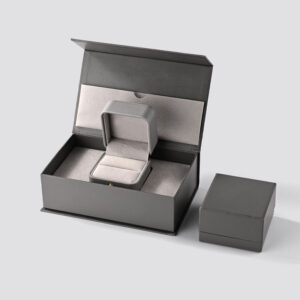
Opening force is not a loose-magnet pull rating
Opening force is the resistance encountered when opening the complete box using a documented method. A direct normal pull rating, by contrast, describes separation of a magnet and a specified steel test piece in a controlled perpendicular direction. The two results answer different questions.
Industrial Magnetics explains pull testing as measuring the force needed to pull a test piece vertically away from a magnet, while gauss testing measures magnetic flux density near a magnet. It also notes that cleanliness, gap, and operator technique can affect pull-test results. That article concerns industrial magnetic separators, not jewelry packaging. Use it only to distinguish measurement terms and to recognize the need for a controlled method; it does not create a jewelry-box test standard, acceptance limit, or service protocol.
A gauss meter is not a direct measure of lid-opening force. It may describe flux density at a probe location, but it does not reproduce the geometry and motion of a user lifting a hinged, wrapped box. Do not substitute a gauss reading for an approved opening-feel assessment.
Likewise, do not convert jewelry weight into a universal required force. Whether a closure is appropriate depends on the box geometry, the product and insert arrangement, the opening gesture, the desired reveal, retail handling, and the buyer’s separate transit plan. Agree the acceptable range with the buyer and packaging engineer instead of adopting a generic number from a component catalog or a search result.
Why identical magnets can feel different in finished boxes
Two boxes described with the same magnet components can feel materially different. The reason is not necessarily a component defect. The complete assembly can alter both engagement and the force path needed to open it.
Consider these variables together:
- Gap at closure. Record wrap, board, adhesive and lining revisions, and check that the lid seats fully.
- Alignment and polarity. Inspect the intended mating position and orientation; record any sideways movement or offset.
- Target and structure. Identify whether the approved design uses a mating magnet or steel target.
- Hinge resistance. Observe spring-back and compare hinge and fold construction between samples.
- Attachment retention. Check for movement, wrap lifting or board separation around the closure.
- Grip and opening path. Keep finger access, lid overhang and the intended opening gesture consistent during comparisons.
- Packed configuration. Check the actual insert, jewelry, accessories and tissue for interference with lid seating.
A buyer decision framework: weak, usable, or too difficult
The goal is not “the strongest possible closure.” The goal is a documented, repeatable experience appropriate to the use case.
Too weak
A too-weak configuration may fail to pull the lid into its intended final position, may leave a visible front-edge mismatch, or may reopen from ordinary handling in the buyer’s stated scenario. It can also feel uncertain because the user does not receive a clear sense that the lid has seated.
Before requesting stronger magnets, inspect the system. Check for a closure gap, misplaced target, incorrect polarity, board warp, packed-product interference, or hinge behavior. Increasing magnetic strength without diagnosing the cause can create a box that is harder to open while leaving the actual construction fault unresolved.
Usable and intentional
A usable configuration closes with the agreed visual seating and can be opened by the intended user at the recorded grip point. Its resistance feels deliberate rather than accidental. The buyer should define that reference feel through approved samples and plain-language observations such as “clear front access,” “no forced prying,” “lid seats flush,” or “no manual repositioning needed.”
This qualitative language is valuable when it is tied to a specific sample, revision, test method, and decision-maker. It stops “premium feel” from becoming an untestable instruction.
Too difficult
A too-difficult configuration can require excessive fingernail use, two hands when the intended interaction is one-handed, awkward twisting, or a sudden release that disrupts the presentation. It may be caused by closure strength, but also by insufficient finger access, a restrictive hinge, or an opening path that fights the lid geometry.
Accessibility belongs in the requirement. State who will open the box, whether gloves or manicured nails are plausible, and how the product must remain presented after opening. Do not assume every buyer wants the same amount of resistance.
The approval workflow for a finished magnetic jewelry box
Use this workflow for a development sample, pre-production reference, or controlled comparison sample. It is deliberately adaptable: the buyer and packaging engineer should set the actual sample count, opening range, repeated-use plan, and environment relevant to the program.
- Write the use brief before evaluation. Identify the jewelry type, packed insert, intended opening orientation, retail or gift use, reference opening feel, user grip/accessibility needs, visual closure expectation, and any known concern such as a tall insert or delicate surface.
- Freeze the sample identity. Give every evaluation box a sample ID and revision. Record the box style, artwork or wrap revision, insert revision, closure layout description, and packed or unpacked status. Photographs may support identification, but the written revision record controls the approval.
- Set the opening method. Record where the operator grips the lid, the starting condition, opening direction, approximate opening angle being observed, and whether the motion is hand-operated or fixture-assisted. If a force gauge is used, document the fixture geometry, attachment point, direction, speed approach, and how peak values are recorded. A gauge result without this context is not comparable.
- Check closure seating and alignment first. Close the lid in the normal intended manner. Observe front-edge position, lid squareness, visible gap, rubbing, need for hand repositioning, and whether the packed insert obstructs seating. Record the condition rather than treating a click as automatic proof of secure closure.
- Assess opening feel at the agreed grip point. Have the agreed operator or operators open the box according to the recorded method. Capture observations of access, smoothness, initial release, hinge behavior, and whether the presentation remains controlled. If comparing alternatives, evaluate them under the same setup.
- Conduct the agreed repeated-opening assessment. Reopen and close the sample according to the buyer-approved plan. Inspect for change in seating, alignment, surface scuffing, wrap lift, board damage, hinge degradation, unusual noise, or closure retention. The plan should not be invented as a universal cycle count; it should reflect the intended use and the buyer’s risk tolerance.
- Separate transit and environment questions. Opening feel does not prove shipping suitability. Define a separate buyer-approved plan for intended environment and transit exposure, including packed configuration and outer protection. For broader planning, review complete packaging transit evaluation.
- Make a recorded decision. Mark the sample pass, hold, or rework. A pass should identify the exact revision and any conditions. A hold should identify missing evidence or an unresolved decision. A rework decision should state the observed issue and the next sample change, rather than merely requesting “stronger magnets.”
- Control production comparison and changes. Retain the approved reference sample where practical. Define how lot drift will be checked against it, who reviews exceptions, and what supplier changes require notification before production. Changes to magnet layout, polarity, target material, board construction, wrap, adhesive, hinge, insert geometry, or closure location should trigger review and may require new sample approval.
Buyer guide: RFQ questions, red flags, and checklist
Use these questions to agree the sample scope and approval record before ordering.
Ask the supplier to confirm the proposed finished-box construction and to identify what will be represented in the sample. Provide the packed product, insert requirements, opening orientation, desired closure appearance, expected user interaction, and any handling or transit conditions the buyer wants evaluated. Request advance notification of any change that could affect closure behavior.
Useful RFQ questions include:
- What exact sample revision is being evaluated, and does it include the intended wrap, insert, and packed product arrangement?
- Where is the intended lid grip point, and can the opening method be documented for comparison?
- What parts of the closure system could change during development or production?
- How will alignment, seating, opening feel, and attachment retention be compared with the approved reference?
- What is the escalation path if a sample shows loose magnets, delamination, board tear-out, or inconsistent closure feel?
- Which proposed changes require buyer notification and new sample review?
Red flags are vague claims such as “strong magnetic closure” without a finished-box sample, a component pull number presented as the lid-opening result, comparison samples built with different wraps or inserts, an undocumented switch in closure construction, or a request to approve from photographs alone. A loose magnet or delamination requires containment and investigation. It is not a default reason to specify stronger magnets.
Compact working checklist:
- [ ] Approved sample ID and revision recorded
- [ ] Packed product and insert state recorded
- [ ] Grip point, opening direction, angle, and speed approach agreed
- [ ] Lid seating, front alignment, and closing behavior observed
- [ ] Repeated-opening assessment agreed and recorded
- [ ] Intended environment and transit evaluated under a separate plan
- [ ] Pass, hold, or rework decision signed off
- [ ] Lot comparison and supplier change-notification rules defined
For closure options within a custom presentation-box discussion, see Ribbon, Bow & Magnetic Closures. For a sample discussion with ON THE WAY, send your finished-box brief with insert requirements, intended opening gesture and approval criteria.
Buyer FAQ
What opening force is required for a magnetic jewelry box?
There is no universal required opening force for all jewelry boxes. Agree an acceptable range and reference feel for the complete packed box with the buyer and packaging engineer. Record the grip point, opening path, angle, and method so that any measurement or hands-on assessment is comparable.
Why can the same magnet feel different in two boxes?
Gap, alignment, polarity, target arrangement, wrap and adhesive buildup, board construction, hinge resistance, insert fit, and the user’s grip point can all change the finished opening experience. Compare like-for-like completed samples before attributing the difference to magnet strength.
Does a click prove that the closure is secure?
No. A click may be a useful subjective cue, but it does not by itself establish alignment, retention, packed-product clearance, repeated-use performance, or transit suitability. Inspect seating and use the buyer-approved assessment plan.
How should repeat-opening assessment be handled?
Set it before approval. Specify the sample revision, opening and closing method, operator or fixture approach, observations to record, and pass/hold/rework route. Review attachment retention, wrap and board condition, hinge behavior, and closure alignment as well as opening feel.
What changes require new sample approval?
Review changes that can alter the system, including closure location or layout, polarity, mating target, board construction, wrap, adhesive, hinge, insert geometry, packed configuration, or opening-access detail. The buyer should decide whether the change requires a new approval sample rather than treating supplier component certification as complete-box approval.