
Custom Jewelry Packaging Solutions for Global Brands
Build premium travel jewelry organizer solutions with factory-direct pricing and low MOQ. Trusted by 300+ jewelry brands across 30+ countries for 17+ years.
Featured Travel Jewelry Organizers


Product Gallery — Design Showcase

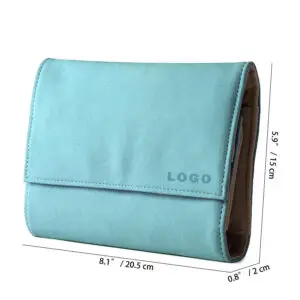


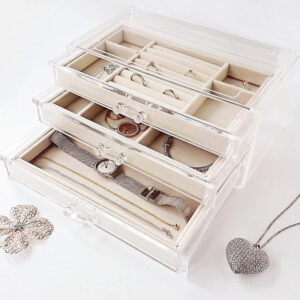


Why Brands Choose On The Way
Factory-direct manufacturing with custom flexibility and proven quality—designed to accelerate your brand’s growth
Factory-Direct Pricing
Own our production line—no middlemen, no markup. Direct costs passed to you for maximum profitability on every order.
Low Minimum Order Quantities
Start with 100 units instead of thousands. Perfect for startups, boutiques, and brands testing new designs without massive investment.
Unlimited Custom Flexibility
Pouches, boxes, displays—your exact specifications. Any material, closure, size, branding. We’ve completed 6,500+ bespoke projects tailored to vision.
Eco-Conscious Material Options
FSC-certified paper, recycled fabrics, reusable components. Align your brand with sustainability without compromising luxury or performance standards.
Rigorous Quality Assurance
Multi-stage professional inspection on every piece. Industry-standard testing, defect detection, finish verification—delivered on time, every time, guaranteed.
Dedicated Account Partnership
Your personal liaison from sampling through production. Seamless communication, custom guidance, and proactive support across 300+ successful brand partnerships.
Solutions Engineered for Every Buyer Need
Each solution engineered for distinct buyer needs: brand protection, retail presentation, showroom display, or cost-effective distribution.
Protecting Designer Collections
Independent jewelry designers need protective travel jewelry organizer pouches that keep delicate pieces safe during transit while reflecting brand identity without requiring large minimum orders.
Custom velvet, satin, and microfiber fabric pouches with personalized branding create premium unboxing experiences and build customer loyalty from first impression to delivery.
Premium Retail Presentation
Boutique jewelry retailers and premium sellers need sophisticated travel jewelry organizer boxes that protect inventory, create impressive in-store displays, and strengthen brand recognition with customers.
Custom rigid gift boxes with magnetic closures and luxury finishes establish premium brand positioning, protect valuable inventory, and create truly memorable moments at retail.
Professional Collection Display
Jewelry retailers and luxury brands need organized, attractive display solutions for their showrooms and galleries that keep collections beautifully arranged while showcasing pieces professionally.
Custom travel jewelry organizer display trays and busts present collections with professional polish, maximize showroom space, and guide customers through curated pieces naturally.
Efficient Bulk Distribution
Wholesalers, distributors, and e-commerce sellers need cost-effective travel jewelry organizer paper bags for large bulk orders that maintain brand consistency with competitive per-unit costs.
Custom branded paper bags with low MOQ enable profitable wholesale distribution, expand your brand reach across retailers, and deliver consistent brand experience at scale.
Premium Materials for Custom Jewelry Packaging

Premium Velvet
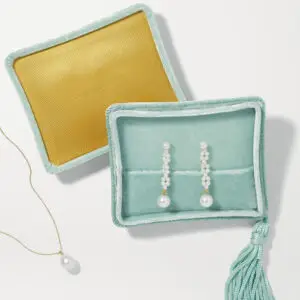
Luxurious velvet offers premium hand-feel with gentle protection for delicate jewelry. Its dense pile absorbs moisture and prevents tarnishing. Ideal for upscale organizers targeting luxury consumers.
Luxury Satin
Smooth, non-abrasive satin protects gemstones and metals from scratches. Its liquid-like sheen conveys elegance while its low-friction surface keeps jewelry secure during travel. Perfect for luxury positioning.

Premium Microfiber
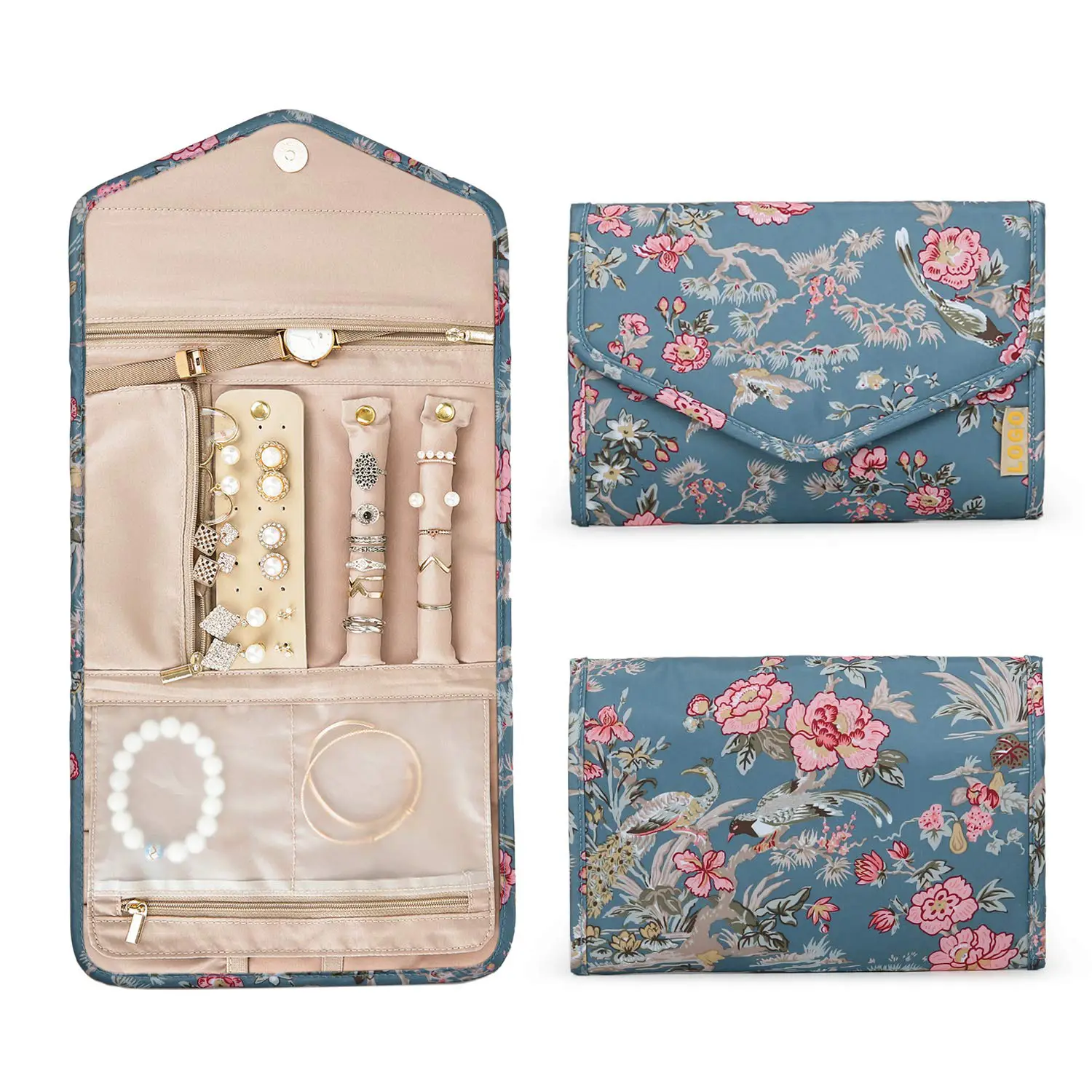
Ultra-soft microfiber combines premium hand-feel with exceptional durability. Its moisture-wicking properties protect against tarnishing, while its resilience withstands repeated travel use. Cost-effective luxury alternative.
Organic Cotton
Breathable organic cotton offers natural sustainability with gentle jewelry protection. Hypoallergenic and machine-washable, it appeals to eco-conscious brands. Versatile base for custom branding and affordable scaling.
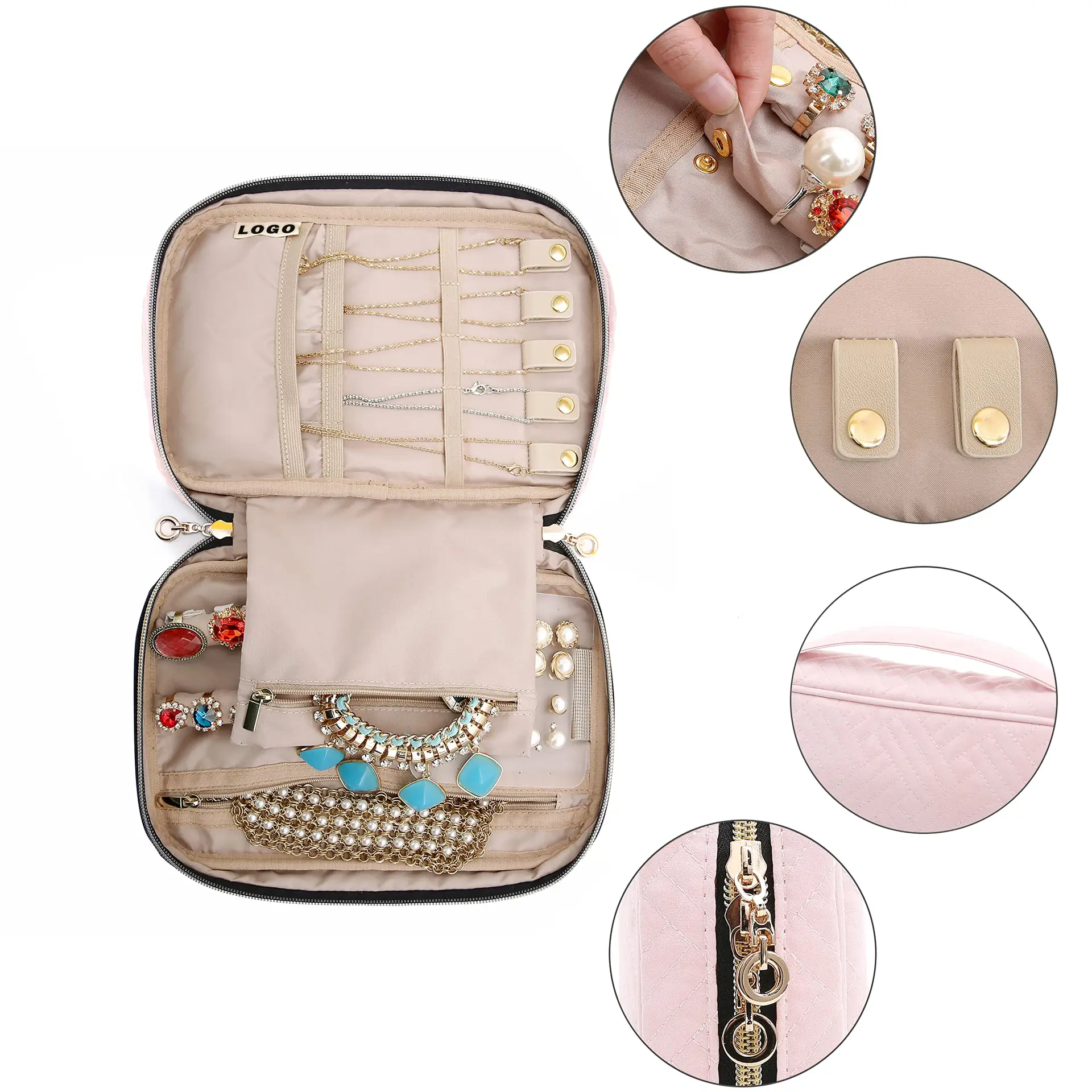
Natural Linen
Natural linen combines durability with eco-credentials, offering a premium, organic aesthetic. Its tight weave protects jewelry while breathable fibers prevent moisture buildup. Ideal for sustainable luxury positioning.

Recycled Eco-Fabrics
FSC-certified recycled materials deliver sustainability without compromising quality. These eco-friendly fabrics appeal to conscious consumers while reducing environmental impact. Perfect for brands aligning packaging with values.
Advanced Production & Customization Techniques
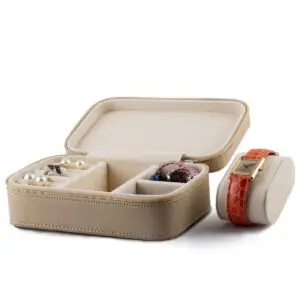
Embossing
Creates raised or recessed logos and designs on organizer surfaces, adding tactile luxury and memorable brand identity that distinguishes premium travel jewelry organizers.
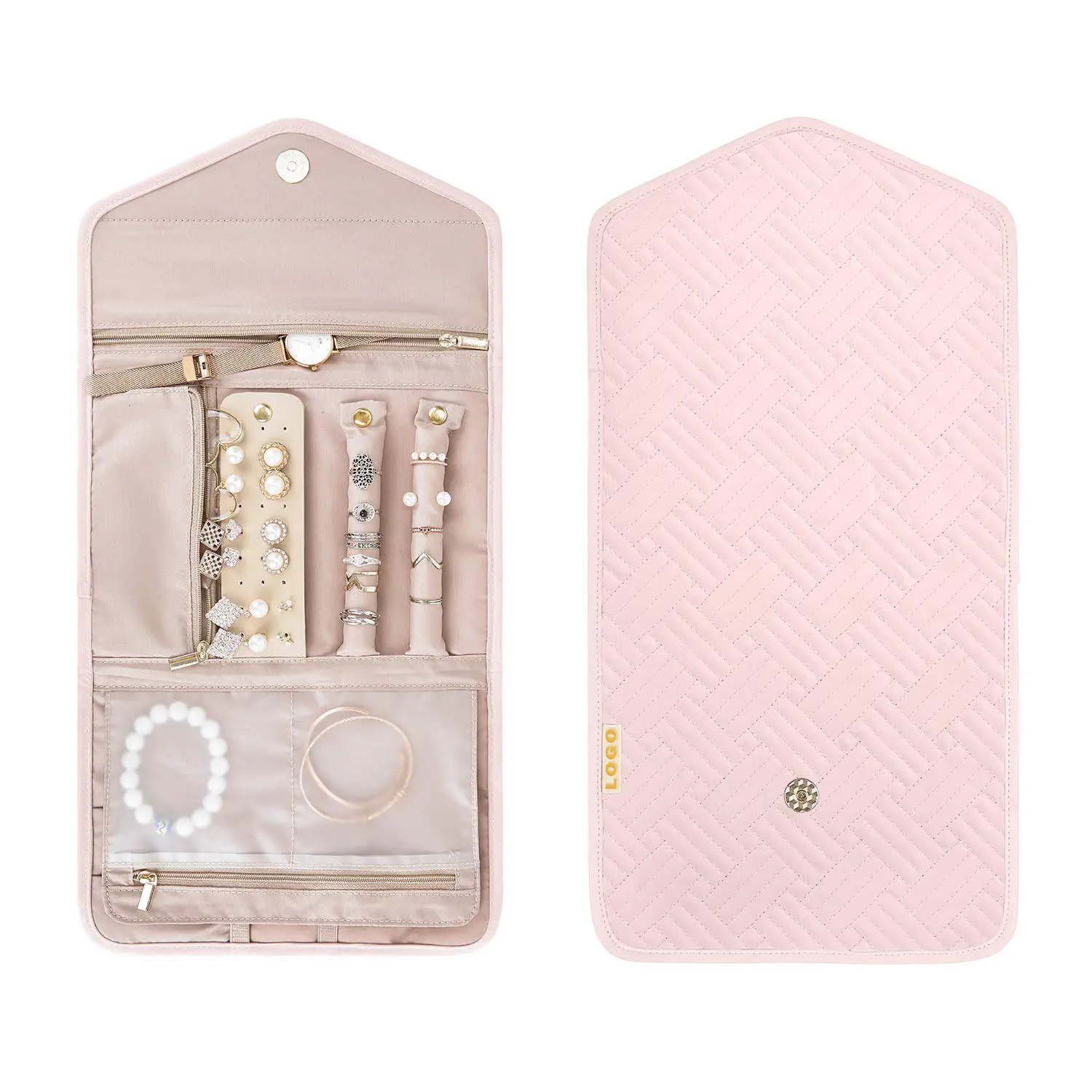
Foil Stamping
Applies metallic gold, silver, or custom-colored foil finishes to travel jewelry organizers, creating brilliant branded accents that catch light and significantly elevate perceived value.
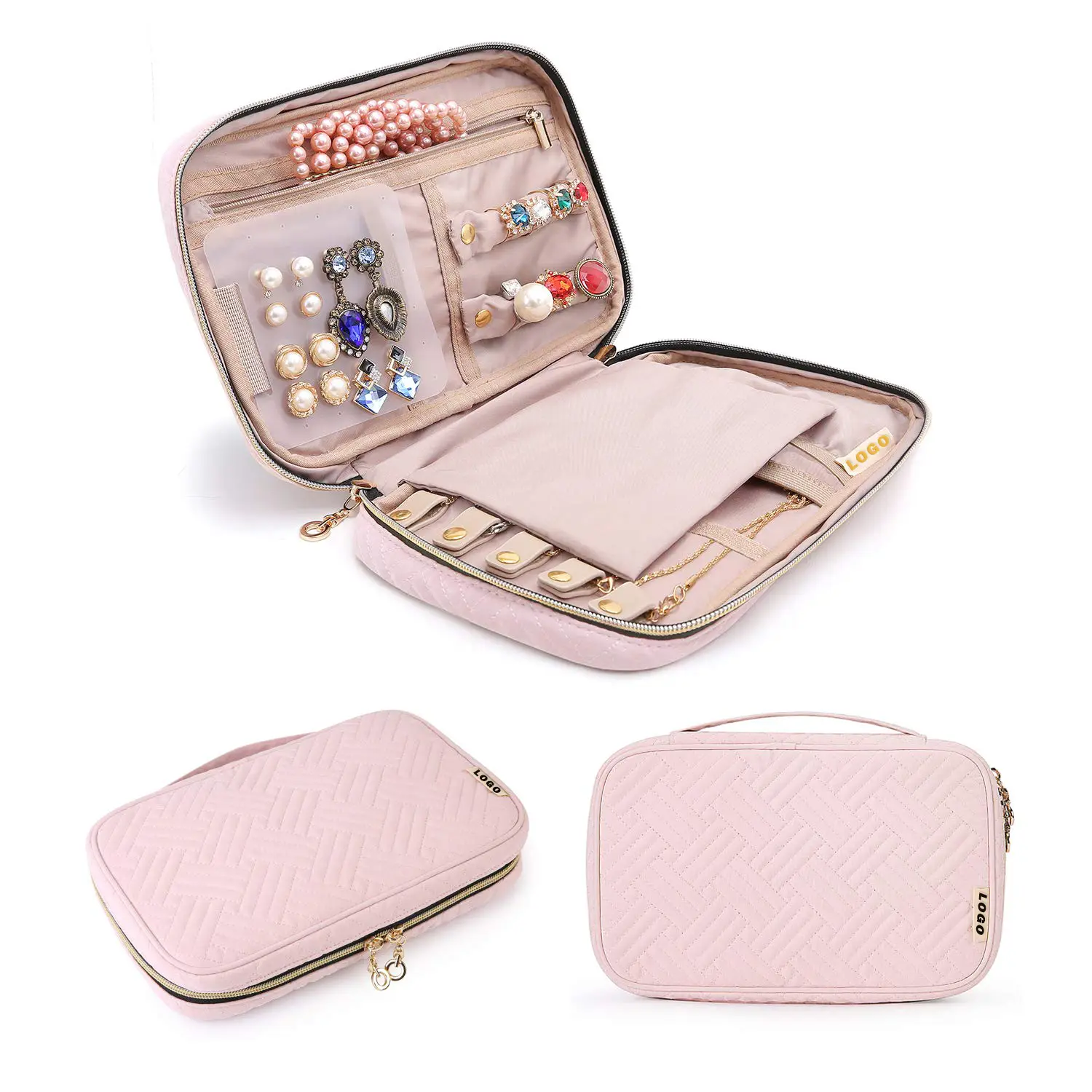
Color Printing
Delivers vibrant, photo-quality multi-color designs on fabric or paper surfaces for travel jewelry organizers, from brand logos to detailed pattern artwork for distinctive visual appeal.

Magnetic Closures
Integrates secure, seamless magnetic fastening systems into premium travel jewelry organizers, ensuring jewelry compartments stay sealed during transit without visible hardware or mechanical wear.
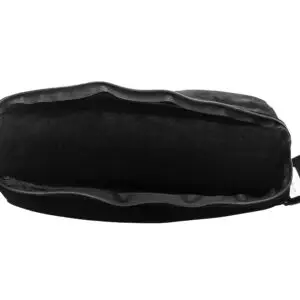
LED Integration
Embeds LED strips or accent lights within travel jewelry organizer interiors to illuminate jewelry displays with luxury ambiance, enhancing product visibility and perceived value during presentation.
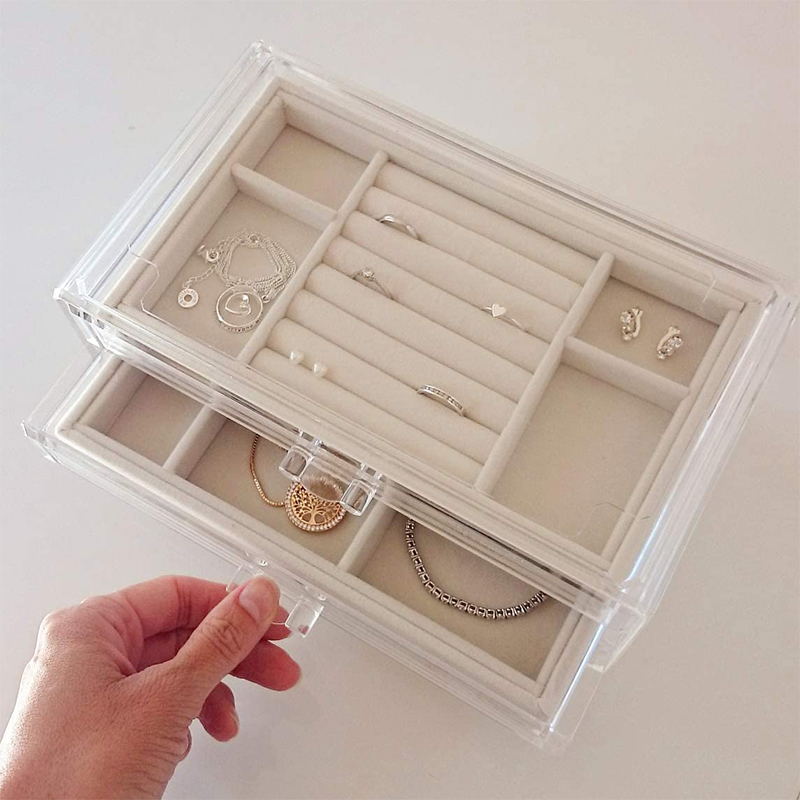
Laser Engraving
Etches precise logos, serial numbers, or custom artwork directly onto travel jewelry organizer materials without dyes or inks, ensuring permanent, high-resolution branding that endures.
Essential Hardware & Components for Premium Packaging

Premium YKK Zippers
High-quality YKK zippers ensure smooth, reliable operation on travel jewelry organizers. Ideal for durability and premium feel. Available in multiple colors and sizes to match your brand aesthetic perfectly.

Luxury Drawcords with Tipping
Satin and cotton drawcords with metal or plastic tipping add premium functionality to travel organizer pouches. Perfect for easy access, secure closure, and authentic brand identity throughout the customer experience.

Custom Woven Labels
Branded woven labels communicate craftsmanship and professionalism. Sewn into travel jewelry organizer pouches and boxes, they reinforce brand recognition and differentiate your packaging from mass-market competitors.

Magnetic Snap Buttons
Durable magnetic closures provide secure, effortless fastening for travel jewelry organizers without visible hardware. Enhance durability and user experience while maintaining a clean, elegant aesthetic for luxury brands.

Tissue Paper Inserts
FSC-certified tissue paper inserts protect delicate jewelry and enhance the luxury unboxing experience. Customizable with brand colors and messaging, they add a final premium touch to every travel jewelry organizer package.

Custom Branded Hangtags
Durable hangtags with your logo and brand story attach to travel jewelry organizers, creating memorable touchpoints. Include product details, care instructions, or QR codes—perfect for omnichannel brand engagement from unboxing onward.
About On The Way — Custom Jewelry Packaging Experts
Founded in 2007 by Joyce Linkwin, On The Way is a China-based manufacturer of premium custom travel jewelry organizers and packaging solutions. Operating from our 1,200 m² Dongguan factory with 220+ skilled staff, we’ve completed 6,500+ bespoke projects for 300+ global brands. Our founding mission: Exquisite packaging, quality living — delivering excellence every step of the way.
We serve jewelry houses, independent designers, and boutique retailers across 30+ countries in North America, Europe, and Southeast Asia, offering premium travel jewelry organizer solutions. Our expertise spans custom velvet, satin, and eco-material pouches; rigid and magnetic-closure boxes; display trays and busts; and branded luxury paper bags. With factory-direct pricing, low minimum order quantities, and full customization flexibility, we empower startups and established brands alike to elevate their packaging.
What sets us apart: a multi-stage QC process ensuring flawless execution, FSC-certified and recycled eco-materials reducing environmental impact, and dedicated account managers guiding every project from sampling to mass production. We believe packaging is your brand’s first impression. That commitment to quality, innovation, and partnership has kept us trusted for 17+ years — and counting.

Core Capabilities: Quality, Flexibility & Partnership
White-Label Travel Jewelry Organizer Solutions
Customize every aspect of your packaging—from design to branding. Our private-label and OEM programs let independent brands and retailers launch their own lines with low minimum orders and full design flexibility. Factory-direct pricing means you keep margins high.
- Private-label & OEM white-label options for independent brands
- Low MOQ starting at 100 units—no massive commitments
- Full customization: materials, colors, logos, packaging, hardware
- Factory-direct pricing with wholesale margins built in
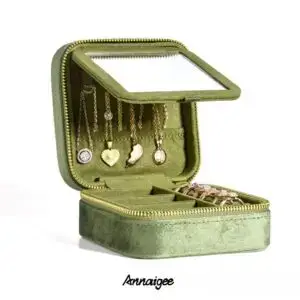
Rigorous QC for Every Travel Jewelry Organizer
Every travel jewelry organizer passes through five inspection checkpoints before shipping. Our dedicated QC team verifies materials, stitching, hardware, printing, and packaging at each stage. Consistency and durability are guaranteed—because your brand’s reputation depends on flawless execution.
- Five-stage inspection from raw materials to final shipment
- Testing for durability: stitching strength, hardware functionality, print quality
- 100% digital photo documentation & traceability per order
- ISO standards compliance & certification across all production lines
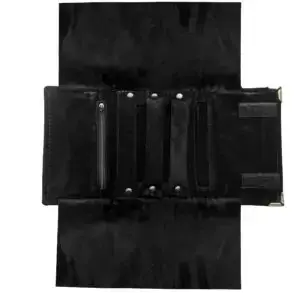
Sustainable Materials for Conscious Brands
Offer your customers eco-friendly travel jewelry organizers built from responsibly sourced materials. We source FSC-certified paper, recycled fabrics, and sustainable closures—all certified and tested. Premium sustainability isn’t a premium cost; it’s a factory-direct advantage.
- FSC-certified paper, recycled fabrics, organic cotton & linen options
- Eco-packaging: reusable pouches, biodegradable boxes, sustainable hardware
- Carbon-neutral shipping & compliance with EU/US environmental standards
- Material transparency—full sourcing & certifications shared with your team

Your Personal Production Partner
From sample approval through mass production, a dedicated account manager owns your project. Real-time production tracking, responsive communication, and on-time delivery are standard—not premium services. We’ve maintained 98%+ on-time delivery for 17+ years across 300+ brands.
- Dedicated account manager for every project, from sample to delivery
- Real-time production tracking & transparent communication milestones
- 98%+ on-time delivery record across 17+ years & 300+ brands
- Rush options available—expedited sampling & production timelines

Why On The Way Outperforms Standard Suppliers
See why 300+ global jewelry brands trust factory-direct manufacturing over traditional suppliers
← Swipe left or right to view →
The Production Process: Design to Delivery
Six transparent phases—from initial design consultation through worldwide shipping—ensure every custom travel jewelry organizer meets our exacting quality standards and yours.
Design Consultation & Sampling
Work with our design team on custom specifications. Receive free samples to validate aesthetics, functionality, and fit for your brand before committing to full production.
Material Selection & Sourcing
Choose from premium fabrics—velvet, microfiber, linen, recycled materials. All materials are FSC-certified or eco-friendly, tested for durability and aligned with your sustainability goals.
Custom Production Launch
Your travel jewelry organizer moves to our dedicated production line. Advanced machinery combined with skilled craftspeople ensure precision, consistency, and quality at every manufacturing step.
Multi-Stage Quality Inspection
Every piece undergoes rigorous multi-stage QC. We inspect materials, stitching, closures, and finishing to ensure your travel jewelry organizer meets exacting standards throughout.
Professional Packing & Preparation
Your jewelry organizers are packed with care in branded boxes or custom packaging. Each unit is prepared for safe transit and professional presentation to your customers.
Shipping & Tracking
Dispatch with real-time tracking from our Dongguan factory to your location worldwide. On-time delivery is guaranteed; your dedicated account manager updates you at every milestone.
Order Your Custom Jewelry Packaging in 5 Steps
From design submission through on-time delivery, we handle every phase of your custom project.
Submit Your Design & Specs
Share your design vision, technical specifications, or reference samples with our team. On The Way assigns a dedicated account manager to guide your entire project.
Request a Quote & Sample
Submit your MOQ, material preferences, and customization needs. Within weeks, receive a detailed quote and complimentary sample to evaluate our quality firsthand.
Approve & Place Order
Review your approved prototype and request any final refinements or tweaks. Once satisfied, confirm your bulk order with locked-in pricing and timeline.
Monitor Production & QC
Our 220-person team launches production with multi-stage quality control inspections. You receive regular factory updates, photos, and progress reports throughout manufacturing.
Receive Your Delivery
We handle end-to-end logistics and arrange on-time delivery to your warehouse or retail location. Unbox your finished custom travel jewelry organizers ready to go.
Quality & Compliance Certifications



How Leading Jewelry Brands Trust On The Way
On The Way cut our packaging costs by 28% while raising quality. Their factory-direct pricing and low MOQ let us scale our travel jewelry organizer line significantly without major upfront capital.
We launched our branded travel jewelry organizer collection in 6 weeks. The custom flexibility, premium materials, and dedicated support made the process seamless. Exactly what our luxury retail partners needed.
Their FSC-certified materials helped us launch sustainable travel jewelry organizers. Zero returns, 100% brand fit, and a smaller carbon footprint. Our customers love the eco-premium packaging—it strengthens our market position.
Custom Jewelry Packaging: Your Questions Answered
Everything you need to know about MOQ, sampling, lead times, customization, and working with On The Way.
What’s the minimum order quantity (MOQ) for travel jewelry organizers?
How much does sampling cost for a custom travel jewelry organizer?
What are the lead times for travel jewelry organizer orders?
Can you customize the design and materials for my travel jewelry organizer?
Do you offer private label and white-label travel jewelry organizer solutions?
What are your payment terms and shipping options?
How do you protect my design and intellectual property?
Can I reorder the same travel jewelry organizer design later?
The Complete Buyer’s Guide to Custom Jewelry Packaging
Master custom travel jewelry organizer sourcing with our comprehensive guide. Learn materials, customization techniques, manufacturer selection criteria, cost tiers, and common buyer mistakes to make informed decisions.
1. What is a Travel Jewelry Organizer?
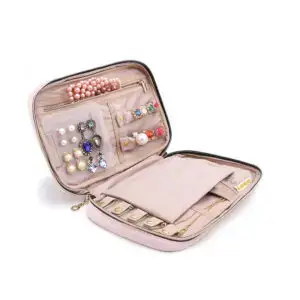
A travel jewelry organizer is a portable, protective storage solution designed to organize and secure jewelry during transit and temporary away-from-home storage. Primary use cases include business travel, leisure vacations, jewelry brand operations, and independent retailers managing inventory at trade shows, markets, and pop-ups. These organizers prioritize accessibility and safety, enabling customers to transport valuable pieces without unpacking an entire collection.
Most functional travel jewelry organizers incorporate 6–10 dedicated compartments, each preventing tangling and scratching through material-specific design (felt-lined slots for rings, padded pockets for earrings, elastic loops for necklaces). Benefits include shock-resistant protection, quick access to individual pieces, and reduced risk of loss or damage. Standard designs weigh 300–500 grams and conform to carry-on luggage dimensions, suiting frequent travelers and mobile retail environments.
Custom travel jewelry organizers serve a branding function beyond storage: they extend a brand’s presence into customer homes, hotels, and daily environments. For independent jewelry designers and boutique retailers, branded organizers reinforce perceived quality and signal investment in customer experience. The selection of materials (velvet microfiber, satin, linen), hardware finishes, and logo placement directly communicates brand positioning and heritage.
Travel organizers differ from stationary bedroom jewelry boxes in three critical dimensions: weight (portability), construction resilience, and compartment efficiency. While furniture-based storage prioritizes display and aesthetics, travel organizers optimize for shock resistance, quick packing, and protective linings—typically velvet, microfiber, or closed-cell foam—to withstand movement and protect high-value pieces during transport.
2. History & Evolution of Travel Jewelry Storage
Early jewelry storage relied on basic cloth pouches—simple muslin or cotton drawstring bags that offered minimal protection and no brand identity. The shift accelerated in the early 2000s when e-commerce growth outpaced brick-and-mortar retail, and luxury brands recognized packaging as a critical first touchpoint. Online retailers demanded protective, branded solutions; boutique jewelers needed differentiation beyond the product itself.
By 2015, the global jewelry market reached $250 billion, with independent designers and boutique retailers capturing growing share through direct-to-consumer channels. Travel jewelry organizers emerged as a core category—portable, protective, and highly customizable. Sustainability became a competitive driver around 2018 when GOTS-certified organic cotton and FSC-certified materials entered mainstream luxury packaging, reflecting consumer demand for ethical sourcing.
Today’s market expects portable organizers to balance protection, sustainability, and brand storytelling. Modern designs isolate compartments to prevent tangling, use eco-friendly closures, and integrate branded logos on microfiber or recycled linen. Custom solutions now allow jewelers to ship inventory and customers to transport pieces with professional presentation—reinforcing brand identity at every touch point.
Manufacturers scaled production to support this shift, completing thousands of custom projects for boutique and luxury brands across 30+ countries. Low MOQ flexibility, factory-direct pricing, and rapid sampling now define competitive advantage, as brands seek travel jewelry organizer solutions that protect both product and margin.
3. Types of Travel Jewelry Organizer Solutions
Five primary travel jewelry organizer formats dominate retail and e-commerce channels, each optimized for distinct protection levels and price tiers. Selecting the right format requires balancing capacity, material durability, and brand perception.
Soft Pouches & Drawstring Bags

Velvet, microfiber, cotton, and satin pouches dominate the budget travel jewelry organizer segment at $0.80–$2.50 per unit (MOQ 500+).
Capacity ranges 2–8 pieces; protection is minimal. Ideal for gift packaging and entry-level retail buyers.
Hard-Shell Protective Cases

Rigid ABS or recycled cardboard with magnetic closure systems protect 4–12 pieces against impact and moisture.
Priced $2.50–$6.00 per unit, they target premium and luxury brands prioritizing unboxing experience and brand perception over cost.
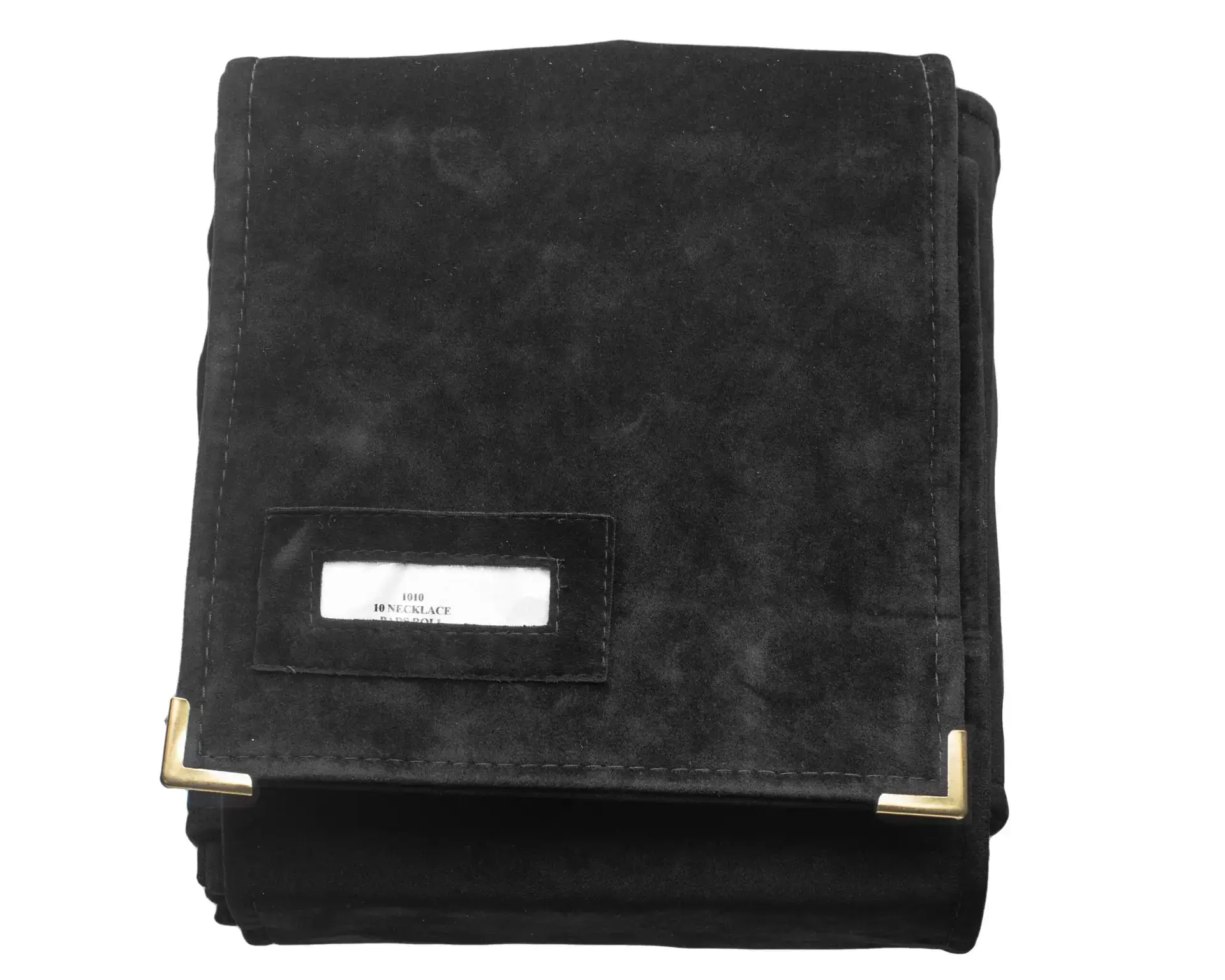
Jewelry Rolls with Compartments

Microfiber and linen roll formats feature 6–20 dedicated compartments securing earrings, necklaces, and bracelets independently.
Priced $1.50–$4.50, they appeal to travelers managing multi-piece collections; flat-pack design minimizes luggage volume.
Hanging Organizers

Polyester frames with velvet-lined pockets hold 8–24 pieces and hang inside luggage or hotel closets, delivering low-medium protection.
Entry pricing ($1.20–$3.50 per unit) suits gift retailers and casual travelers storing non-precious or costume jewelry.
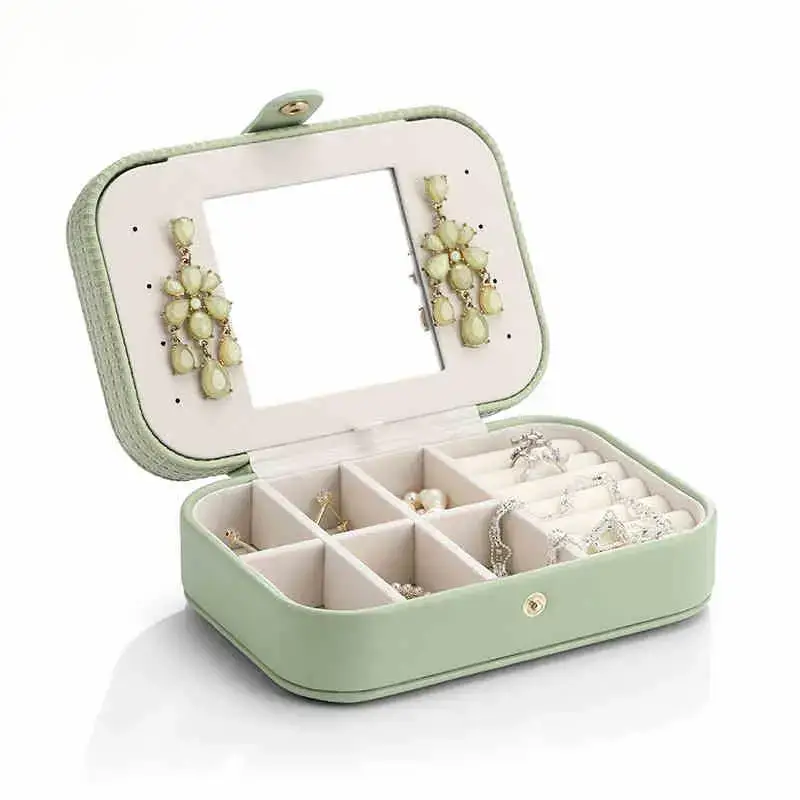
Compact Travel Boxes
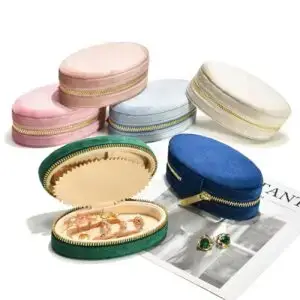
Magnetic-closure boxes with recycled or kraft cardboard hold 3–10 pieces and deliver highest protection and brand perception.
Priced $2.00–$5.50, they justify premium positioning through sustainability certifications and luxury gift-set appeals.
4. Materials for Quality Travel Jewelry Organizer Construction
Material selection is central to travel jewelry organizer quality, durability, and brand positioning. Fabrics, linings, and hardware each carry distinct cost-to-value tradeoffs. Understanding these choices enables better design and pricing decisions.
| Material | Durability | Aesthetic Appeal | Cost Tier |
|---|---|---|---|
| Velvet | High | Luxury | Premium |
| Linen | Medium | Refined | Mid |
| Microfiber (lining) | Very High | Functional | Mid |
| Recycled Polyester | High | Versatile | Mid |
| Vegan Leather | Medium | Premium-look | Premium |
| Organic Cotton | Medium | Natural | Mid |
Premium Exterior Fabrics

Velvet (600–800 GSM) delivers luxury perception but requires protective backing to prevent crushing. Linen provides refined aesthetics at moderate cost. Cotton options (150–250 GSM) balance affordability with breathability. Silk alternatives cost 2–3x more, reserved for ultra-premium brands.
Protective Linings and Hardware

Microfiber linings (80–120 GSM) protect jewelry while adding minimal bulk. Felt batting prevents shifting during transit. YKK zippers, magnetic closures, and metal hardware increase durability significantly. These components typically add 15–25% to unit cost but substantially extend product lifespan and customer satisfaction.
Sustainable and Eco-Friendly Options
Recycled polyester reduces environmental impact by 20–40% compared to virgin materials. Organic cotton and vegan leather substitutes appeal to conscious buyers. OEKO-TEX and FSC certifications command 5–15% premiums. These options strengthen brand narrative and support positioning in boutique retail channels.
Material Impact on Pricing and Perception
Material costs typically represent 25–35% of total unit cost for luxury travel jewelry organizers. Premium fabric selections support 40–60% retail markups. Eco-certifications and transparent sourcing differentiate mid-market brands. Quality material messaging justifies price positioning and builds trust with wholesale partners.
5. Customization & Branding Options for Travel Jewelry Organizer
Effective customization transforms a travel jewelry organizer from commodity to brand asset. From color matching to embroidery constraints and sustainable packaging inserts, strategic choices at ordering stage impact both cost and perceived value.
Color Selection & Print Placement
Pantone-matched colors require no upcharge for standard ranges.
Print placement—typically centered on fabric or leather surfaces—costs $0.15–$0.45 per unit depending on method (screen, digital, foil). Minimum order quantities drop to 100–500 units for single-color prints on pouches.
Logo Embroidery & Embellishment

Embroidered logos require minimum 1×1 inch dimension; smaller designs become illegible. Embroidery adds $0.50–$2.50 per unit at 100–500 MOQ, rising on lower volumes.
Beading, sequins, or embossing on magnetic-closure boxes incur tooling fees ($200–$600) amortized across the run.
Interior Layouts & Customization Tiers
Standard layouts (ring slots, necklace hooks, compartments) ship at baseline cost.
Bespoke configurations—custom tray dies, fabric-lined compartments, LED-lit cases—incur design fees ($150–$400) plus $0.20–$1.00 per unit. Lead time extends 4–6 weeks for die customization; stock layouts compress to 2–3 weeks.
Branded Packaging Inserts & Hang Tags

Custom hang tags with brand logos and product care instructions cost $0.05–$0.15 per unit at 1,000+ volume.
Tissue wrapping and branded insert cards add another $0.08–$0.20. FSC-certified cardstock inserts align with luxury positioning and cost under $0.12 per piece in bulk.
Sustainable Wrapping & Eco-Materials
Recycled kraft paper, compostable poly mailers, and natural cotton wrapping meet rising consumer demand. Switching from standard plastic to plant-based films costs $0.04–$0.10 per unit.
Certifications (FSC, OEKO-TEX, GOTS on organic cotton pouches) add credibility but no material cost at 500+ unit orders.
6. Quality & Construction Standards to Verify
Quality separates premium organizers from commodity products. Verify stitching durability, closure reliability, padding consistency, and material longevity before committing to production. Establish non-negotiable benchmarks during sample approval.
Stitching Quality & Seam Durability

Double-stitched seams with 18-20 stitches per inch withstand repeated packing cycles. Inspect for consistent tension, no skipped stitches, and reinforced corners.
Ultrasonic stitching on microfiber prevents fraying without adding bulk.
- Double-stitched, 18-20 stitches per inch minimum
- No skipped stitches or loose tension
- Reinforced corners and attachment points
Closure Mechanisms & Cycle Testing
Magnetic snaps and zippers must survive 1,000+ open-close cycles. Magnetism should retain 95%+ potency at 1,000 cycles; YKK zippers maintain function after 10,000 cycles.
Request durability testing reports and certifications pre-production.
- 1,000+ cycle durability testing required
- YKK or equivalent slider quality
- Pre-production test reports and certification
Padding & Lining Adhesion

Consistent padding density (2-3mm polyether or memory foam) prevents jewelry shifting during transport. Adhesive must pass 180° peel testing without separation.
Microfiber and satin linings should not shed fibers under pressure.
- 2-3mm padding density uniformity throughout
- 180° peel-test bond strength ≥5N/cm
- No-shed lining fibers under use
Edge Finishing & Water Resistance
All cut edges require binding, welting, or heat-sealing to prevent fraying and jewelry snagging. Velvet edges are hand-rolled; synthetics are heat-sealed or RF-welded.
Conduct AATCC-35 water-resistance and AATCC-16 color-fastness testing. Verify CPSIA jewelry safety compliance.
- Bound or heat-sealed edges throughout
- AATCC-35 water-resistance testing required
- CPSIA jewelry safety standards compliance
RFQ Quality Specifications
Include explicit quality benchmarks in your RFQ: stitch count, closure cycles, padding density, edge treatment, and required test certifications.
Request a pre-production QC checklist signed by your manufacturer’s quality team before approving samples for bulk production.
7. How to Choose the Right Manufacturer
Selecting a manufacturer shapes your travel jewelry organizer program. Evaluate partners on lead time, MOQs, certifications, responsiveness, and pricing transparency.
Minimum Order Quantities & Lead Times
Most Asia-based factories require 500–2,000 unit MOQs for custom pouches and boxes. Sampling runs 4–8 weeks; production 6–10 weeks.
North America charges 20–40% premiums for faster turnaround. Confirm both in writing.
Certifications & Compliance
Require ISO 9001 for quality systems, OEKO-TEX or FSC for material sustainability. GOTS (organic cotton) and BSCI audits verify labor-practice compliance.
Request certificates during preliminary talks. Delays or evasion indicate weak controls.
Sample Process & Communication
First samples typically require 2–4 weeks. Test email response time: reliable partners answer technical queries within 24–48 hours.
Confirm a dedicated account manager for your project. Poor communication at sampling stage signals production bottlenecks.
Regional Sourcing Trade-offs
China undercuts domestic suppliers 30–50% but requires longer commitments. Southeast Asia offers 3–5 week turnarounds (vs. 6–8 mainland China) with modest premiums.
Nearshoring to Mexico costs more but enables rapid customization loops.
Critical Vetting Questions
Use these standard questions to assess partnership fit and capability:
- Minimum order quantity and sample timeline?
- Which certifications and supporting documentation?
- Three jewelry-brand references in my segment?
- Dedicated account manager and response SLA?
- First-sample charges and revision-round policy?
Production Capacity Assessment
Verify facility size (200+ m² standard), staffing (50+ for reliable throughput), and annual output. Request a detailed QC walkthrough with inspection frequency checkpoints.
Overcapacity and documented processes signal reliability; understaffed operations invite cost-cutting.
8. Common Mistakes When Sourcing Travel Jewelry Organizer
Most sourcing errors erode margins before first sale. Understanding the most common pitfalls—MOQ negotiation, durability testing, interior sizing, inventory validation, and customization cost structures—prevents costly corrections later in mass production runs.
Underestimating MOQ and Lead Time
Jewelry box manufacturers often enforce MOQ of 500–2,000 units to optimize factory capacity.
Ignoring MOQ requirements forces rush fees (15–30% markup) or splits across multiple shipments, eroding margin.
Lead times of 6–10 weeks demand advance planning; last-minute orders risk product delays and retail stockout penalties.
Skipping Durability Testing
Velvet, satin, and microfiber linings each perform differently under moisture and friction.
Testing samples against humidity (40–60% RH) before bulk production catches defects like color bleeding or material breakdown.
A single quality failure in 500+ units can destroy brand reputation and force costly recalls or customer refunds.
Poor Interior Configuration
Ring rolls, necklace hooks, and earring slots must match target jewelry dimensions—oversizing creates excess weight and packaging bloat; undersizing causes product damage in transit.
Brands miss this by skipping prototype testing with actual jewelry samples.
Misaligned interiors typically increase customer returns by 12–20% in first shipments.
Over-Ordering Without Validation
Market demand is rarely predictable from launch.
Ordering 10,000 units without pilot testing or pre-orders locks capital and storage.
Excess inventory depreciates 5–10% monthly and risks markdown pressure. Smart brands validate demand with 500–1,000-unit pilot runs, then scale based on sell-through rates—keeping inventory lean.
Misaligned Customization Costs
Custom printing, edge coating, and hardware upgrades add 15–40% to base unit cost—but are often quoted per-unit without volume negotiation.
Brands underestimate total project cost and face margin compression mid-production.
Transparent cost breakdowns at MOQ tiers prevent sticker shock and enable accurate retail pricing from the outset.
9. Steps to Launch Your Custom Brand Line
Launching a custom travel jewelry organizer line requires structured planning across 3–6 months from concept to production. Synchronize market research, design iteration, production setup, inventory planning, and launch timing to minimize delays and risk.
Market Research & Customer Profiling
Begin with customer discovery: conduct 50–100 interviews to validate demand and price sensitivity. Document use cases, pain points, and feature priorities.
This early-stage validation prevents costly design pivots and ensures product-market fit before committing to production tooling.
Design Brief & Sample Development
Create a detailed design brief specifying dimensions, materials, hardware, finishes, and branding requirements. Allocate 4–6 weeks for sampling with 2–3 revision cycles—standard lead time when working with flexible manufacturers.
Approve samples before committing to tooling or production orders.
Tooling & Production Readiness
Finalize tooling specifications (dies, embossing plates, structural molds) once samples pass QC. Lead time: 2–4 weeks depending on complexity.
Simultaneously establish production parameters: inspection protocols, defect thresholds, packing requirements, and compliance certifications (FSC, OEKO-TEX). Multi-stage QC prevents costly production errors.
Production Timeline & Inventory
Manufacturing lead time: 6–8 weeks post-tooling. Develop 90-day demand forecasts based on pre-orders or sales pipeline.
Reserve 15–20% safety stock for reorder cycles and unexpected demand spikes. Coordinate air/ocean freight timing 2–3 weeks pre-shipment to avoid storage costs.
Pricing Strategy & Launch Execution
Calculate landed cost: materials, labor, tooling amortization, quality control, and logistics. Benchmark against comparable products; apply 2.5–3x wholesale markup.
Execute phased launch: pre-sales during sampling, formal launch at trade shows, parallel retail partnerships. Gather early customer feedback to refine subsequent production runs.
10. Pricing & Cost Structure
On The Way’s factory-direct model accepts minimum orders starting at 100 pieces, with unit-cost discounts increasing at 500 and 1,000+ volume tiers. Standard cotton pouches cost $2.80–$3.50 at 100–250 units, declining to $2.00–$2.50 at 250–500, $1.50–$2.00 at 500–1,000, and $1.20–$1.60 at 1,000+ units. Lead times compress from 4–5 weeks at smaller volumes to 2–3 weeks at 1,000+.
Material grade and component additions directly impact per-unit cost: premium microfiber runs 20–30% higher than cotton canvas; magnetic closures add $0.80–$1.20 per unit; LED lighting adds $1.00–$2.00. China-based manufacturing from established suppliers typically yields 40–60% cost savings versus domestic manufacturers. Sourcing directly from the factory (no distributor markup) strengthens this advantage.
Request detailed quotes itemizing material, labor, customization setup, and packaging separately. This transparency enables you to identify cost-reduction opportunities without compromising brand perception—swapping embroidery for screen print, for example, can cut per-unit costs by 60–70% if design complexity permits.
| Method | Setup Fee | Per-Unit Cost | Lead Time Add | Best For |
|---|---|---|---|---|
| Screen Print (1–3 colors) | $150–$300 | $0.50–$1.50 | 1 week | Logo, text, simple designs |
| Digital Print | $200–$500 | $0.80–$2.50 | 1–2 weeks | Complex art, photography |
| Embroidery | $300–$600 | $1.50–$4.00 | 2–3 weeks | Premium placement, durability |
11. Getting Started: Next Steps for Your Sourcing
Over 6,500 completed custom projects across 3,000+ cooperative customers reveal a consistent pattern: buyers who request samples before committing to bulk orders reduce redesign cycles by 40–60%. Before drafting your RFQ, confirm five core specifications: material composition (velvet, microfiber, cotton, linen, or recycled alternatives), exterior dimensions and compartment depth, closure type (magnetic, snap, zipper, or ribbon tie), color count (Pantone-matched shades vs. standard), and printing method (screen, foil, emboss, or digital). These decisions directly impact MOQ flexibility, lead time (typically 30–45 days from approved sample), and unit cost at scale.
Minimum order quantities for travel jewelry organizer solutions range from 500–2,000 units depending on customization complexity and material selection. Request a formal sample—most reputable manufacturers deliver turnkey samples within 10–14 days—and evaluate fit, finish consistency, and durability under handling stress. Budget 10–15% above negotiated unit pricing for initial sampling, testing, and minor adjustments; this investment prevents costlier errors in mass production.
The 30–45 day lead time from approved sample to mass production means supplier selection must happen early. Contact vetted manufacturers with clear specifications, production timeline, target retail price point, and desired launch date. Ask for references from brands in your segment and review portfolio images of completed travel jewelry organizer designs. Confirm FSC certification, OEKO-TEX compliance, and on-time delivery guarantees before issuing a purchase order. Your packaging is your first impression—choose partners who share your quality standard.
Launch Your Custom Jewelry Packaging Line Today
Low MOQ, eco-friendly materials, fast production. Serving 300+ brands worldwide. Submit your tech pack, request a quote, or arrange a free sample today.