
Jewelry packaging scuff resistance testing helps buyers compare how a specified printed surface responds to controlled rubbing before approving production. It is most useful when it is tied to the actual wrap, ink, coating, and contact scenario—not treated as a promise that a finished jewelry box will remain flawless through every shipment, display, and customer handling event.
Why a small surface mark can become a large approval issue
A jewelry box is often picked up, nested, opened, photographed, repacked, and placed into a bag. A mark on a pale uncoated wrap may be subtle; a similar mark on a dark solid lid, high-gloss field, metallic graphic, or soft-touch surface can be immediately visible. That does not make every premium finish unsuitable. It makes the approval brief more important.
The buyer’s practical question is not simply, “Does this box pass a scuff test?” It is: “Which surface is being evaluated, against what contact, under which documented conditions, and what visible change is acceptable for this use?” Those details turn a vague durability request into a decision that can be repeated when artwork, materials, or finishing changes.
For a starting point on formats that may need this level of specification, see jewelry box formats. The structural format and its show surfaces should be identified before selecting a test plan.
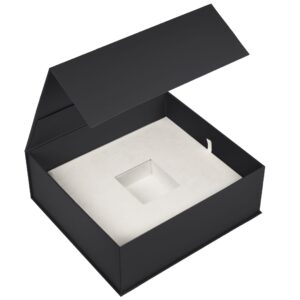
Define the failure you are trying to prevent
Buyers and suppliers can use the same word for different defects. Put the intended meaning in the approval record.
Scuff or abrasion is visible surface wear caused by rubbing contact. It may appear as dulling, whitening, loss of color density, disrupted gloss, or removal of part of a printed or coated layer.
Ink transfer is material moving from the printed surface onto the contacting surface, often called a receptor in a controlled rub procedure. It is different from a mark that stays on the original print.
Scratch is a line, gouge, or localized break caused by a harder or sharper contact. Rub testing involves repeated surface contact; it does not automatically represent a sharp-object scratch event.
Finish change is any noticeable shift in sheen, texture, color appearance, or tactile feel. A surface can retain its ink while still looking unacceptable because gloss has become uneven or a soft-feel effect has burnished.
These distinctions matter because one sample may show no transfer but still have a conspicuous gloss change. Another may retain its appearance but transfer color to a clean opposing surface. An approval criterion should say which outcome matters for the project.
What ASTM D5264 can—and cannot—tell a jewelry-box buyer
ASTM D5264-98(2019) is a standard practice for comparing the abrasion resistance of printed materials in laboratory conditions using a Sutherland Rub Tester, or equivalent, with full-width rubber pads and standardized receptors. ASTM describes it as applicable to printed materials and as a way to compare printed inks, coatings, laminates, and substrates. It also notes that abrasion damage in actual use depends on variables such as shipping conditions, temperature, humidity, and time. ASTM D5264-98(2019)
That framing is useful for a printed paper wrap on a rigid jewelry box. It provides a disciplined way to compare candidate surface stacks on flat specimens. For example, a buyer may compare two versions of the same black printed wrap, or assess whether a proposed protective coating changes the visible result under one agreed procedure.
It is not a certification for a complete jewelry box. A flat printed specimen cannot recreate every edge, corner, seam, closure, tray, liner, or packing interaction in an assembled structure. It also does not establish that a carton will survive a particular distribution route. Treat it as comparative evidence for the specified flat printed substrate, then separately inspect the assembled sample where real construction introduces contact points.
A good request names the version: ASTM D5264-98(2019). “ASTM rub test” alone leaves too much room for different equipment, setup, and interpretation.
Where TAPPI T830 fits—and where it does not
TAPPI T830 is used to evaluate resistance of inks to dry or wet rubbing and scuffing. The Industrial Physics summary also describes use on coated containerboard, unprinted containerboard, and similar surfaces, with visual comparison to internal standards as a common evaluation approach; instrumental evaluation may also be used. Industrial Physics: TAPPI T830 testing
This can be relevant when the item under discussion is a printed board or containerboard-related surface and the buyer needs to distinguish dry rub, wet rub, smear, bleed, or transfer concerns. It should not be selected by default just because a jewelry package contains paperboard.
A foil detail, velvet exterior, leather-like covering, textured paper, laminated wrap, and rigid-box corner do not automatically share the same failure mode or suitable procedure. Nor should a TAPPI containerboard-oriented result be substituted for a flat printed-wrap comparison without agreement that the material and contact scenario are appropriate.
The same source cautions that T830 assesses rub resistance under conditions different from other scuffing and rubbing methods, so results are not necessarily comparable across methods. Industrial Physics: TAPPI T830 testing This is the central comparison rule: a result only has meaning beside another result produced with the same agreed procedure and recorded conditions.
Separate the flat wrap from the assembled package
Use two connected approval tracks.
Track one: flat printed-substrate comparison
This track asks whether a defined ink/coating/substrate stack performs acceptably under a stated laboratory rub procedure. It is appropriate for comparing alternatives before box making commits the wrap to the finished structure.
Keep the comparison narrow. If one candidate uses a different paper, ink system, coating, curing route, or receptor, document the difference instead of presenting the outcome as a direct like-for-like ranking. A result is evidence about that stack in that test setup.
Track two: assembled-box visual and handling review
This track examines the finished jewelry box under realistic project contacts: lid corners touching in nesting, seams at folds, friction from inserts, contact with tissue or bags, and handling during packing and opening. It can reveal weaknesses that a flat test cannot represent, including edge wear, cracking at a score, lifting at a seam, or a finish that changes appearance around a raised logo.
Do not call this handling review an ASTM or TAPPI result unless it actually follows the agreed method. Label it plainly as an assembled-sample inspection or project-specific handling evaluation. The distinction protects the usefulness of both records.
Build a test brief before samples are judged
A test request should be a short controlled specification, not an email asking for “anti-scratch packaging.” Include the following fields:
- The complete surface stack: base substrate, printed colors, metallic or special effects, coating, laminate, varnish, and any tactile finish.
- The show surface and its risk areas: broad dark solids, high-gloss graphics, lid top, logos, corners, scores, seams, or exposed wrap edges.
- The method and version, including whether ASTM D5264-98(2019), TAPPI T830, or another project-specific procedure is being requested.
- Sample conditioning and whether the print and coating have completed their agreed cure before testing.
- The contact arrangement: specimen orientation, contact material or receptor, and whether dry, wet, heated, or another condition is relevant.
- The agreed operating settings, including load and cycle count, stated in the report rather than assumed from a method name.
- The evaluation method: visual review against a retained control, transfer observation, image record, or an agreed instrumental measure where appropriate.
- The acceptance wording and who has authority to approve an exception.
This does not require inventing a universal threshold. A restrained criterion can be specific without pretending every brand has the same tolerance: for instance, require no objectionable visible finish change on the designated show surface when compared with the approved clean control under the agreed viewing conditions. The project team must define what “objectionable” means before the result is seen.
A comparison framework for wraps and finishes
Choose the test focus based on the visible risk, not the finish name alone.
Dark or saturated printed wraps deserve close visual comparison because disruption in a large solid field can show readily. Ask whether the concern is color removal, whitening, gloss disruption, transfer, or all of these.
High-gloss or spot-gloss areas should be reviewed for haze and uneven reflectance, not only ink loss. A surface may be intact yet look rubbed at ordinary viewing angles.
Matte and soft-touch effects need a retained clean control because burnishing or texture change can be more important than transfer. Compare the same lighting and angle each time.
Foil, embossing, and raised decoration require an assembled-sample check around edges and relief. A flat adjacent area may be suitable for a controlled material comparison, but it does not prove the durability of every decorative boundary.
Textured wraps and porous papers may make subtle defects harder to score consistently. Define the sample viewing method and retain a reference sample; avoid treating a casual photograph as a complete acceptance record.
Velvet, leather-like coverings, and other non-paper exteriors should be assessed using a material-appropriate project plan. A containerboard-related rub approach is not a universal substitute for those surfaces.
The decision is not necessarily “add more coating.” A different coating can change color, sheen, touch, folding behavior, or the character of the brand presentation. Compare options as buyer choices against the approved visual target.
Approval workflow for comparable results
- Map the product journey. Identify where the visible exterior makes contact: production handling, nesting, bagging, storage, shipping pack-out, retail display, and customer opening. Separate likely surface-to-surface rubbing from corner or sharp-contact hazards.
- Freeze the candidate stack. Record the exact wrap, artwork revision, inks, coatings, and decorative processes. If there are multiple box sizes or colorways, decide which is the representative risk sample and which need independent review.
- Choose the right evidence. Use a flat printed-substrate procedure for a controlled comparison of the wrap stack; use an assembled sample for corner, seam, closure, and handling inspection. State the method version if a standardized method is used.
- Agree conditions before testing. Specify conditioning, cure status, contacting receptor, test condition, operating settings, and result-review method. Do not set pass language after an unfavorable result arrives.
- Retain a clean control and master sample. The control supports consistent visual comparison. The master sample is the signed reference for color, finish, construction, and the accepted level of natural variation.
- Review evidence together. Look for ink transfer, color loss, haze, whitening, dulling, texture change, and edge damage. Review the designated show surfaces under agreed lighting rather than relying on a single cropped image.
- Record disposition and change control. Log the sample identity, method, conditions, observations, approval decision, and any exception. If the ink, coating, wrap supplier, artwork coverage, curing process, structure, or pack-out contact changes, decide whether the prior evidence still applies.
This workflow does not offer a zero-scuff guarantee. It creates a traceable basis for approving an identified design and for knowing when a later change needs fresh review.
Pre-approval control points
Before authorizing production, a buyer can confirm these points in one concise review:
- Is the ink, coating, and substrate stack named completely?
- Have dark solids, high-gloss areas, and other high-visibility surfaces been singled out?
- Is there a signed master sample plus a clean control for comparison?
- Are flat-wrap results clearly separated from finished-box edge and seam checks?
- Is the planned contact representative of handling and shipping pack-out, without being mislabeled as transit proof?
- Are method/version, conditioning, receptor, cure status, operating settings, and evaluation record captured?
- Does the approval record state what changes require re-review?
FAQ
Does an ASTM D5264 result certify an entire jewelry box?
No. It is laboratory comparison evidence for printed materials under the specified procedure. Finished-box corners, seams, structure, pack-out, and real distribution conditions need separate evaluation.
Can we compare two suppliers’ “rub-test passes” directly?
Only if the method and version, conditioning, specimen stack, receptor/contact, operating settings, and acceptance approach are aligned. Different procedures can produce results that are not directly comparable.
Should foil or soft-touch surfaces use TAPPI T830 automatically?
No. T830 can be useful for inks and relevant containerboard-like surfaces, but it should not be automatically applied to every decorative or non-paper jewelry-box surface. Define the material and failure mode first.
What is the difference between scuffing and ink transfer?
Scuffing is visible wear or appearance change on the original surface. Ink transfer is material deposited onto the contacting surface. Both may matter, but they should be observed and recorded separately.
When should we reapprove the finish?
Re-review when a material, coating, ink, artwork coverage, cure condition, construction detail, or meaningful contact scenario changes. The original approval only supports the documented sample and conditions.
To define a wrap and finished-box approval brief with ON THE WAY, send your artwork, box format and intended pack-out through the packaging project inquiry.