
For most new jewelry brands, the best first system is not “boxes or pouches” but a controlled combination: use pouches for soft protection and lower-cost orders, then reserve rigid boxes for fragile pieces, gifting, premium collections, and retail presentation. The decision should follow the product’s protection needs and the customer promise—not a packaging trend.

A rigid box creates structure, presentation space and a consistent location for inserts and branding.
Quick decision: when should a jewelry brand use a box or a pouch?
Choose a box when the item can bend, tangle, crush, lose a stone, or arrive as a gift. Rings, structured earrings, fine chains with delicate pendants, and matched sets usually benefit from a fitted insert inside a rigid presentation box. Choose a pouch when the item is already durable, the shipping pack supplies the needed structure, and compact storage matters. Fabric pouches can work well for bracelets, simple chains and lower-priced add-ons.
Do not ask the presentation pack to replace the shipping pack. A velvet pouch may protect a polished surface from rubbing, but it does not stop a courier parcel from being compressed. A jewelry box may present the product beautifully, but it still needs an outer mailer or shipping carton sized to survive distribution.
Compare the two formats before requesting quotes
| Decision factor | Jewelry box | Jewelry pouch |
|---|---|---|
| Crush protection | Strong when structure and insert are matched | Limited without a rigid outer pack |
| Tangle control | Good with slots, tabs or shaped inserts | Depends on carding and how the chain is secured |
| Gift presentation | Strong, especially for premium products | Informal to premium depending on fabric and finish |
| Storage and freight | More volume per unit | Compact and usually easier to store |
| Branding area | Lid, sleeve, ribbon, insert and interior | Logo print, foil, embroidery, label or drawcord |
| SKU flexibility | Inserts must suit the product | One pouch can sometimes serve several products |
Founders discussing packaging online repeatedly raise the same trade-off: boxes improve perceived presentation and protection, while pouches reduce cost, waste and storage pressure. Those comments are useful demand signals, but your final decision should come from a packed-product test and a landed-cost comparison.
Build a modular system instead of too many packaging SKUs
A new brand rarely needs a different box for every product. Start with one brand system and a small number of physical formats. For example, use one ring/earring box, one necklace box and one general-purpose pouch. Keep the exterior color, logo treatment, care card and typography consistent so the customer sees one brand even when the structure changes.
Modularity also makes reordering easier. If three collections share the same outer box and only the insert or sleeve changes, slow-moving packaging is less likely to trap cash. Before approving a quote, map each jewelry SKU to its presentation pack, insert, care card and shipping pack. Any product without a clear mapping is a future packing error.
Specify the insert before choosing the exterior
The insert is the working part of a jewelry box. It controls movement, presentation angle and contact surfaces. Tell the supplier the product dimensions, chain length, clasp position and any fragile areas. Ask how the item is secured and how quickly a packer can load it without forcing the jewelry.
Foam, flocked foam, paperboard, molded pulp and fabric-covered inserts behave differently. The right choice depends on product weight, finish sensitivity, sustainability goals and the look of the collection. Request an assembled sample with the real product—not an empty box photo. Then shake, rotate and open the pack several times to see whether the jewelry migrates.
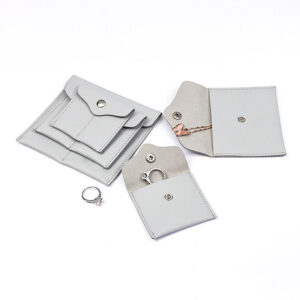
A pouch can be the presentation layer for durable items or the protective inner layer inside a box.
Price the complete pack, not just the box or pouch
Compare landed packaging systems line by line: presentation pack, insert, logo process, card, ribbon, protective wrap, assembly labor, outer shipper, freight and storage. A low unit price can become expensive if the format ships mostly air, requires slow hand assembly, or needs another protective layer.
Also separate one-time costs from repeat costs. Dies, plates, tooling and sample charges should not be confused with the recurring unit price. Ask how price changes by quantity and whether unused components can be shared across future orders. The goal is a repeatable system, not merely the cheapest first invoice.
Test the customer experience and fulfillment workflow
Run two tests. First, pack ten orders at normal working speed and record where staff hesitate. Second, ship samples through the expected delivery route and inspect scuffing, movement, crushed corners and moisture exposure. Photograph the pack before and after transit.
Your approval checklist should include color under agreed lighting, logo position, opening resistance, odor, loose fibers, insert fit, product movement, carton labeling and barcode placement. Stickers should not cover the branded surface or leave residue on a reusable pouch. Customer discussions about disappointing packaging often mention exactly these practical details, not only the visual design.
A sensible first-order packaging brief
Send the supplier a brief containing product photos and dimensions, intended retail price band, sales channel, target presentation, required protective performance, preferred materials, logo artwork, pack quantities and delivery destination. Ask for blank structural samples before investing in every decorative option.
If your range is still changing, begin with neutral stock structures and customize the elements customers notice most. Once sales data shows which products and gift occasions matter, move proven SKUs into more specialized custom jewelry boxes. That sequence protects cash while building a packaging system that can grow with the brand.
Plan packaging by jewelry category
Rings need a slot or pad that holds the band upright without scratching the finish. Stud earrings need holes or tabs spaced so posts and backs do not collide. Drop earrings need enough vertical clearance to avoid bending hooks or tangling pairs. Necklaces need controlled anchor points for the chain and pendant, while bracelets and bangles need space that reflects their diameter and rigidity.
Create a simple product-risk score for every SKU. Rate fragility, tangling risk, surface sensitivity, replacement value and gift likelihood. A high-risk item usually justifies a fitted box. A low-risk, self-supporting product may work in a branded pouch with a card, provided the shipping pack supplies crush protection. This makes the decision repeatable when new products are added.
If one pack serves several jewelry types, test the worst-case product in that group. A box that fits a small pendant may fail when a longer chain is added. A pouch that holds a bracelet may allow two earrings to rub. “Universal” packaging is useful only after the range has been physically packed and handled.
Decide which branding process fits the material
Logo performance changes by substrate. Foil stamping can create a sharp premium mark on paper and some wrapped boxes, but fine lines and large solid areas need testing. Screen printing can work on fabric pouches, while embroidery adds texture but may distort lightweight material. Metal badges, ribbons, sleeves and printed cards create other cost and assembly implications.
Supply vector artwork and specify final logo dimensions, color, position and orientation. Ask for a production-method proof on the intended material. A digital mockup cannot show foil pinholes, fabric show-through, pile direction or how a drawcord interrupts a logo. Approve acceptable variation as well as the ideal appearance.
Brand consistency does not require the same process everywhere. It requires a controlled relationship among color, scale, typography and placement. A small foil logo on a box and a one-color print on a pouch can belong to the same system if they follow the same visual rules.
Add sustainability claims only after material verification
Avoid broad claims such as “eco-friendly” without defining the attribute. Ask for the material composition, recycled-content evidence where claimed, coating and lamination details, insert material, adhesive information and disposal route in the target market. A paper-looking box may contain foam, magnets, plastic film or mixed laminates that affect recyclability.
Reduce unnecessary volume before relying on marketing language. Right-sizing the pack, sharing structures across SKUs and eliminating unused inserts can lower material and freight. A reusable pouch may extend useful life, but only if customers actually keep and use it. The most defensible statement is specific: describe what the package contains and how the customer should separate or reuse it.
Packaging failure modes to catch before launch
Common failures are predictable. Chains escape their tabs and arrive tangled. Earrings rotate until posts pierce the lining. Dark velvet sheds fibers onto light jewelry. Foil rubs off at the corners. Magnets interfere with the intended product or closure. Drawcord ends scratch a polished surface. Inserts lift when a customer removes the item, and oversized shipping cartons allow the presentation box to move.
Turn each risk into a test. Load and unload the product repeatedly. Leave the packed sample closed for several days, then inspect odor and pressure marks. Rub branded surfaces with clean white cloth. Expose a shipping sample to vibration and ordinary temperature changes. Measure packing time and count how often staff need to reopen the pack.
Record the approved solution with photos. When bulk arrives, inspect a sample from more than one carton and production date. Packaging components from different lots can vary in shade, fit or adhesive performance even when each looks acceptable alone.
Frequently asked questions
Should every jewelry order include both a box and a pouch?
No. Use both only when each layer has a job. A pouch inside a box may prevent surface rubbing and add reuse value, but it also adds cost, material and packing time. If the insert already secures the product and the box meets the presentation promise, the pouch may be unnecessary.
Can one jewelry box insert fit rings, earrings and pendants?
Convertible inserts can cover several categories, but they must be tested with real products. Extra cuts and slots can make an insert look less premium or reduce holding strength. A small family of inserts inside one exterior box is often more controlled than one insert trying to do everything.
Is a pouch enough for e-commerce shipping?
Usually not by itself. The outer mailer or carton must provide the structure, space control and environmental protection the product needs. Test the complete shipping system, including filler and sealing method.
When should a startup move from stock packaging to fully custom boxes?
Move when product dimensions, repeat order volume and brand presentation are stable enough to justify tooling, inventory and storage. Sales data should show which sizes deserve customization. Until then, a stock structure with controlled branding can preserve flexibility.
What should be approved in a pre-production sample?
Approve structure, dimensions, insert fit, color, logo, material hand feel, opening action, product loading, packing sequence and shipping performance. The approved sample should carry a code that appears on the purchase order and inspection checklist.